
How to choose a business idea when starting from zero
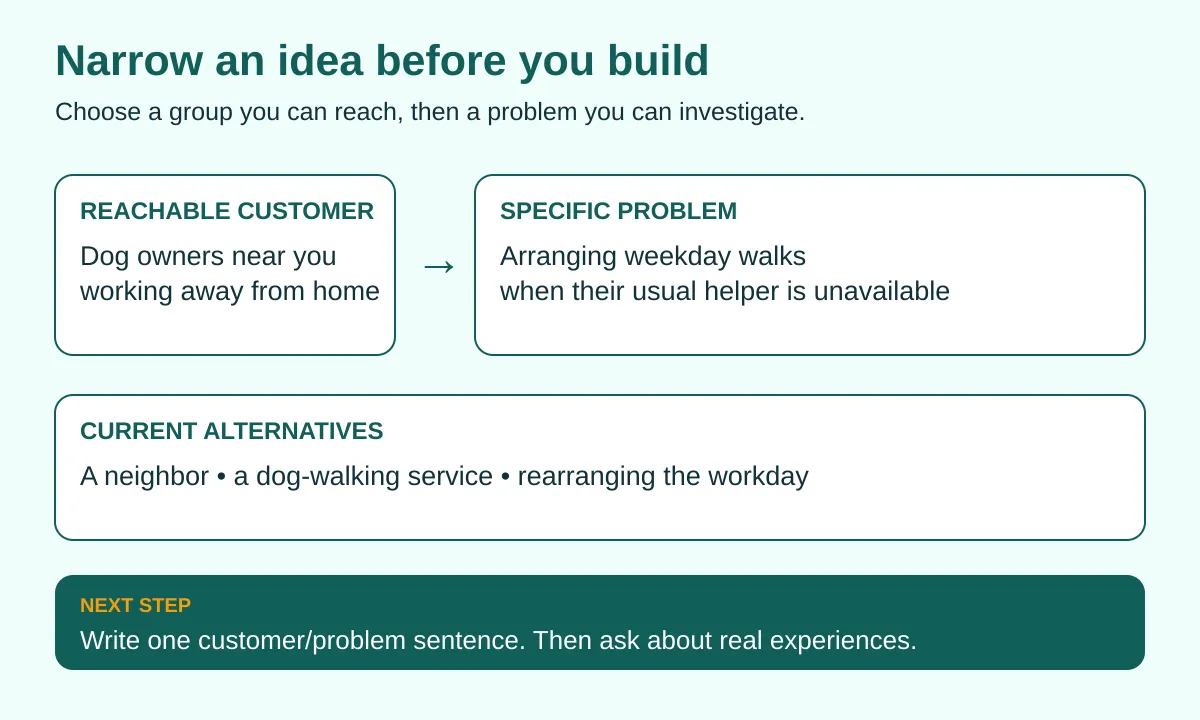
To choose a business idea, start with one customer group you can reach and one specific problem they face. Compare how they handle that problem today, then pick a direction you can investigate without a large commitment. Your first choice is a starting point for learning, not a decision to spend months building.
How to choose a business idea: start with access
A reachable customer group is a set of people you can realistically contact and learn from. “Anyone who wants to save time” is too broad; “independent café owners near me who manage their own staff schedules” gives you somewhere to start.
List three groups you already understand or could reach through work, local businesses, hobbies or communities. For each group, write:
- Where could I find people in this group?
- What work or recurring tasks do I know something about?
- Could I arrange a conversation without paying for advertising?
Access is useful because it lets you check your assumptions. It doesn't mean everyone you know is a potential customer. Friends who don't experience the problem can't tell you much about it.
If you have no obvious network, choose a group with an accessible setting: a local trade association, an open professional community or businesses with public contact details. Follow community rules and ask permission rather than posting a sales pitch.
Name a problem that happens in a specific situation
A problem describes something a person struggles to do, not the product you want to sell. “An app for pet owners” names a solution. “Finding someone to walk the dog on a weekday when the usual helper is unavailable” names a situation to investigate.
Say you enjoy working with animals and can reach dog owners in your neighborhood. Narrow the idea like this:
| Starting point | More useful version | What still needs checking |
|---|---|---|
| Pet owners | Nearby dog owners who work away from home | Can you reach people who fit this group? |
| They need help | Arranging weekday walks when their usual helper is unavailable | Does this happen often enough to matter? |
| I could offer dog walking | Backup weekday walks in a small local area | Would owners trust and choose your service? |
Nothing in that table proves demand. It gives you a clear subject for research.
Write down the trigger, the task and the consequence: when something happens, the customer struggles to do something, which causes a specific difficulty. A consequence could be extra work, a delay, an avoidable cost or a task left unfinished. Don't supply the consequence from your imagination if you can ask someone who has experienced it.
Compare current alternatives, including doing nothing
People may already solve the problem through another business, a spreadsheet, a friend or a workaround. Sometimes they accept the inconvenience. All of these compete with a new offer.
For the dog-walking direction, your research might cover these possibilities:
| Possible alternative | What to investigate |
|---|---|
| Asking a neighbor | How reliable is that arrangement, and what happens when nobody is available? |
| Booking an existing dog walker | What do local services offer, charge and require before a first booking? |
| Rearranging the workday | What does the owner actually change, and how disruptive is it? |
| Taking no action | Is the problem too minor or infrequent to prompt a change? |
Check public service pages for the existing offers. Then ask owners what they actually used. A competitor's presence can show that an offer exists; it doesn't prove that your version will attract customers.
Look for a possible difference you could deliver: a smaller service area, a particular schedule or help with one overlooked task. “Better service” is too vague. Describe what would change for the customer and find out whether that change matters.
Business.govt.nz's guide to validating a business idea also recommends assessing the need, competition and basic economics before major commitments.
Choose the direction you can learn about next
Put your strongest directions side by side. Use “yes,” “no” or “unknown” rather than a score that makes guesses look precise.
- Can I reach people who face this problem?
- Can I describe a recent situation where it might occur?
- Do I know what people use instead, or where to find out?
- Could I eventually deliver a small version with my skills and available time?
- Can I investigate without risking money I need for essentials?
Favor the direction with a clear group, a clear problem and an affordable way to learn. If two look equally promising, choose the one you can investigate sooner. Keep the other in your notes rather than researching everything at once.
If delivery would involve animal care, safety, regulated work or handling sensitive information, identify the qualifications, permissions and insurance you may need before offering it. Being able to interview a customer doesn't mean you're ready to provide the service.
Avoid these three selection traps
- Choosing only because a topic is popular. Attention doesn't tell you which customer has a problem or whether you can serve them.
- Treating your own frustration as proof. Personal experience is a useful starting point; other people's circumstances may be different.
- Buying tools before clarifying the task. A website, logo or software subscription won't answer who needs your help. A notebook is enough for this exercise.
Write your customer/problem sentence now
Complete this sentence before you research another idea:
I want to help [one reachable customer group] who struggle with [a specific task or problem] when [a concrete situation occurs].
For the direction above: “I want to help dog owners in my neighborhood who struggle to arrange weekday walks when their usual helper is unavailable.”
Keep the proposed product out of the sentence. You want room to discover a different solution if your first guess is wrong.
Your next action: write one sentence, name where you can find people who fit it, and ask one of them about the last time that situation happened. Use our customer interview questions and evidence notes to prepare that conversation.