
How to test a business idea with customer interviews
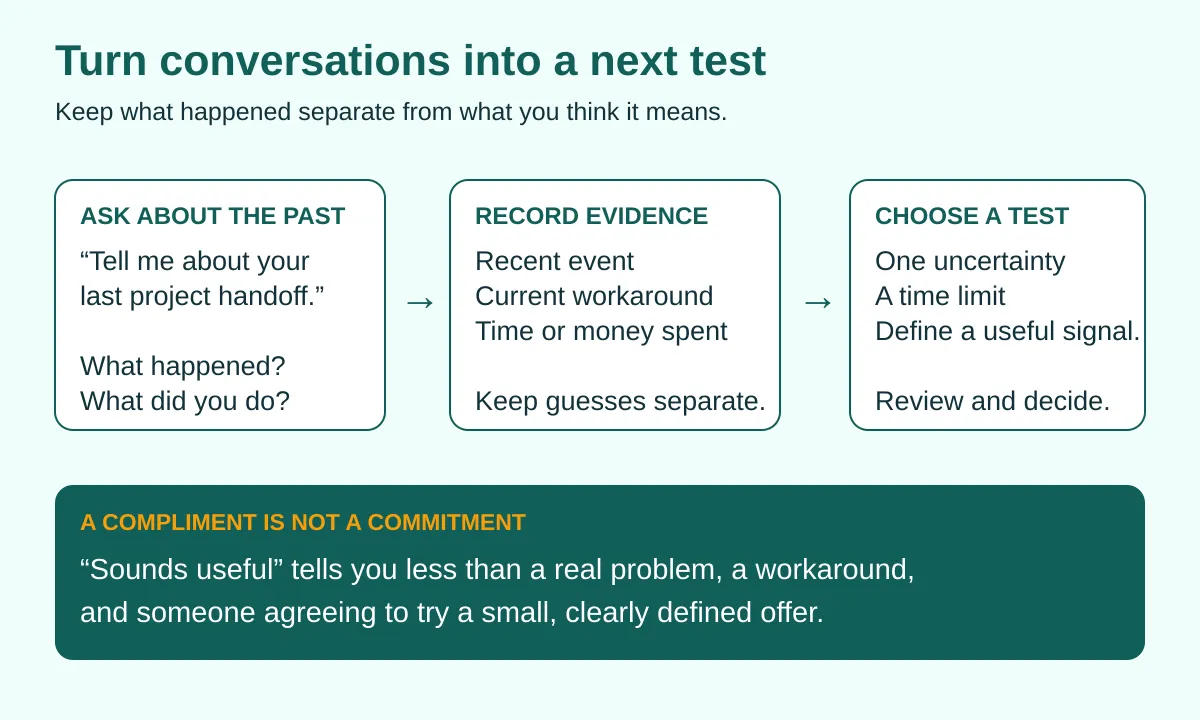
To test a business idea with customer interviews, talk to people who experience the problem and ask what happened the last time they faced it. Record their actions, current workarounds and consequences separately from your own interpretation. Use that evidence to choose a small next test; friendly reactions alone don't show that someone will buy.
Start with one question you need to answer
A customer interview is a conversation designed to learn about a potential customer's experience. At this stage, your job is to understand the problem before explaining your proposed solution.
Write down the customer group, the problem you suspect and the uncertainty you want to reduce. If you can't name the first two, start with our exercise for choosing a business idea.
Say you're considering a service that helps freelance designers collect client feedback before handing over finished work. Your research question could be: “How do freelance designers handle scattered feedback near the end of a project?” That leaves room to discover that the real difficulty is something else—or that their current process works well.
Find people with relevant experience
Recruit people who have recently done the task, not just people who like your idea. For the design-service direction, look for freelancers who work directly with clients and have recently completed a project involving feedback.
Possible starting points include professional communities that allow research requests, local coworking groups and introductions from people you know. Ask a short screening question: “Have you handled feedback directly from a design client recently?” A relevant stranger can be more useful than a supportive friend outside the group.
Try a small first batch of three to five conversations so you can practice the questions and notice differences. That's a manageable starting point, not a sample size that proves a market exists. Include people beyond your immediate circle and seek different experiences, including people happy with their current solution.
Use a short invitation:
Hi, I'm learning how freelance designers handle client feedback near project handoff. Have you worked on a project like that recently? If so, would you be open to a 15-minute conversation about how it went? I'm researching the process, rather than selling anything during the call.
Use that last sentence only if it's true. Keep your request clear, follow community rules and respect a refusal. Don't collect more personal information than you need.
How to test a business idea with customer interviews
Start by explaining the topic and asking permission to take notes. If you want to record the conversation, ask first and respect the answer. Then move from a recent event to the details of what happened.
A short question script:
- “Tell me about the last project where you collected client feedback.”
- “Walk me through what happened, from requesting feedback to finishing the work.”
- “Which parts, if any, were difficult?”
- “What did you do to handle that?”
- “What tools or people were involved? What worked well about them?”
- “What happened because of the difficulty—if anything? How much extra time or cost did it involve?”
- “When else has something similar happened? Was that project typical or unusual?”
- “Have you tried changing the process? What happened?”
If someone mentions paying for help, ask who chose it and who approved the expense. The person using a service may not be the person buying it.
Let the person finish. Follow up with “Can you give me a specific example?” when an answer stays broad. Don't turn “Everything is a mess” into evidence until you understand what actually happened.
Harvard Innovation Labs' guide to validating customer demand recommends non-leading questions about customer experiences rather than opinions about your idea. It also describes starting with a manually delivered service before building a full product.
Replace questions that invite polite agreement
| Avoid asking | Ask instead | What you learn |
|---|---|---|
| Would you use my feedback service? | How did you collect feedback on your last project? | The current process |
| Wouldn't one place for comments be easier? | What worked well, and what was difficult? | Their priorities without suggesting yours |
| Would you pay for this? | Have you paid for anything to handle this task? What led to that decision? | Past spending and buying context |
| Do you often lose time on revisions? | What happened during the last round of revisions? | A concrete event and its consequences |
Past spending can help you understand priorities, but it doesn't establish a price for your offer. Test a clearly defined offer and price later, when you can actually deliver it.
If you show your proposed solution, do it after exploring the current process and label the reaction separately in your notes. Otherwise, you risk interpreting a compliment about your pitch as evidence about the problem.
Record evidence separately from your interpretation
Immediately after each conversation, fill in the same note structure. Use a participant code rather than a full name when you don't need identifying details.
- Relevant context: role, type of work and when the event happened.
- Recent event: what the person described doing.
- Current alternative: tools, people or workarounds used.
- Consequence: time, cost, delay or frustration they reported; write “not established” if you didn't learn it.
- Exact words: a short quote only if you captured it accurately. Otherwise mark the note as a paraphrase.
- Your interpretation: what the account might suggest.
- Open question: what you still need to find out.
For the design direction, keep “feedback arrived through email and chat” separate from “a combined-feedback service might help.” The first is the kind of observation you're looking for; the second is a possible solution to test. Don't write either as a finding unless a real conversation supports it.
Review similarities and contradictions across your notes. Count only what you actually recorded. Three accounts of a problem in a hand-picked group don't tell you how common that problem is across all freelancers.
Choose a small next test based on what you heard
Your next test should address the biggest remaining uncertainty, rather than move automatically to building a website.
| What the evidence suggests | A useful next step |
|---|---|
| People can't recall a relevant problem, or the impact is minor | Revisit the problem or group before building |
| A recurring difficulty appears, but people are happy with their workaround | Investigate what would make a change worthwhile |
| Relevant people describe a costly difficulty and unsatisfactory alternatives | Offer a small, clearly scoped trial you can deliver |
| People want help, but delivery would take too much time or cost | Test whether a narrower service is workable |
For the freelance-design direction, a trial could be manually organizing one project's feedback into a revision checklist. Agree on scope, permission to handle the material and what you will return. Keep confidential client information out unless the designer has permission to share it.
Before starting, write four things: the uncertainty, the test, a limit on time and spending, and the result that would justify another step. You might limit a manual trial to one project and two hours, then assess whether the designer used the checklist and requested a follow-up. Those are chosen test limits, not industry benchmarks.
A trial can reveal whether the help is useful and practical to deliver. It still leaves pricing, repeat demand and the costs of running a business to investigate.
Send one invitation today
Choose one person who fits your customer group and send a short research invitation. Prepare the recent-event questions, create a blank evidence note and decide when you'll review what you learned.
You can do this with a notebook or a document you already use. No paid tool is required. Your next action is a relevant conversation—not a bigger commitment to an untested idea.